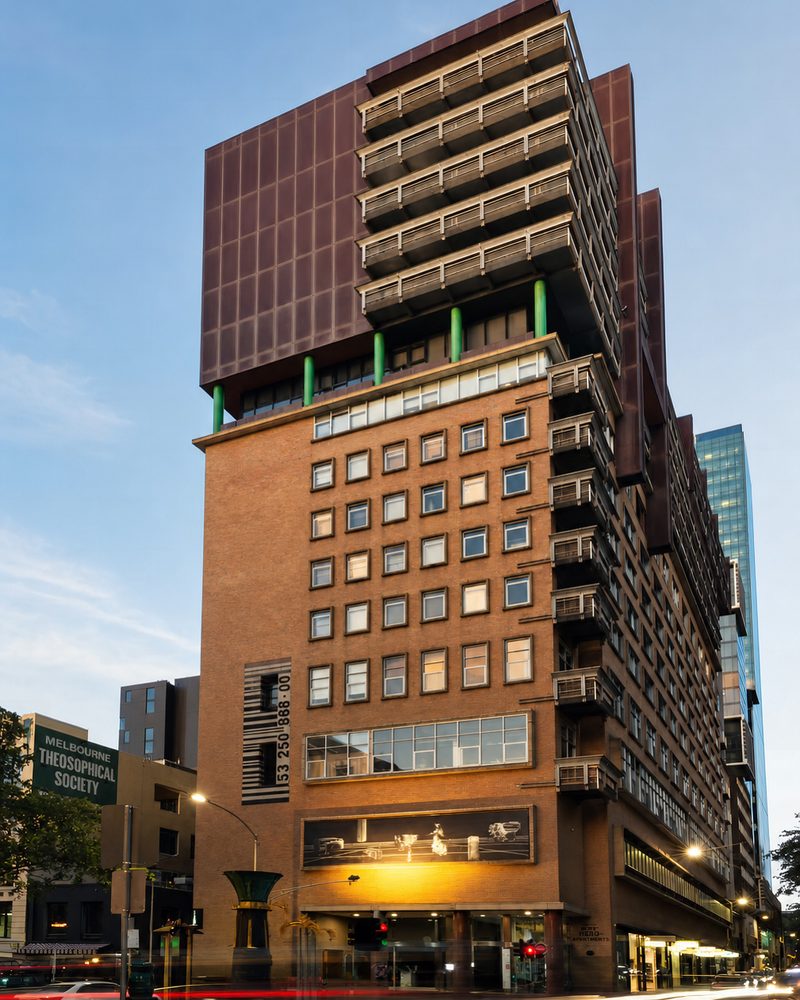

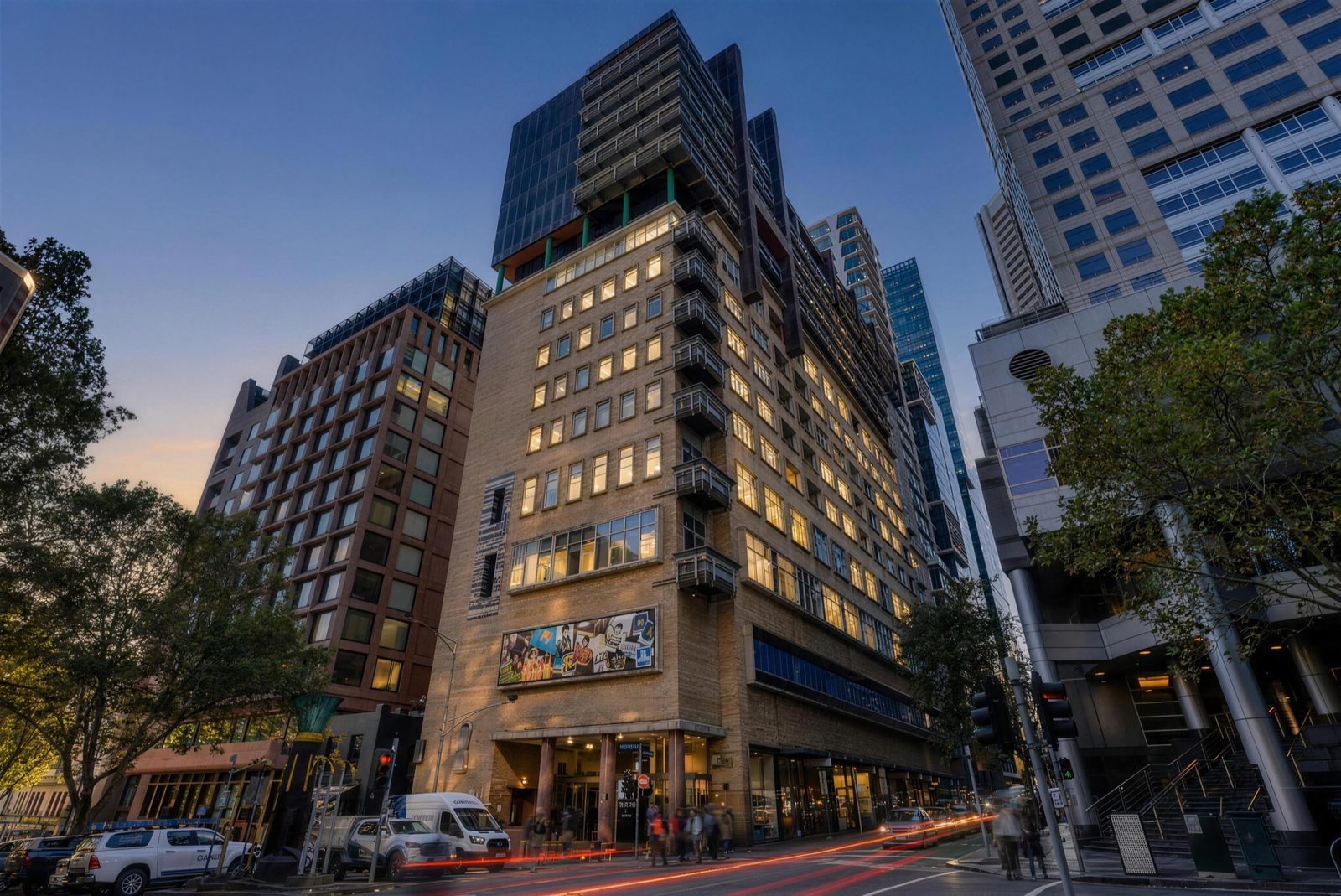
Hero Apartments stands on the north-east corner of Russell and Little Collins Streets, on the rise the old sources call Russell Hill. It was built by the Commonwealth between 1948 and 1954 as the Russell Street Automatic Telephone Exchange and Postal Building, and it became apartments in 2001, when Nonda Katsalidis set six new storeys on its roof. Down the hill, Russell Street ends at the Forum's tower; up the other way stood the police headquarters of 1943, now apartments too.
When it opened it was the first big building completed in the city since 1940. It had taken six and a half years, and its budget had more than doubled — estimated at £436,250, finished at just over a million pounds. The Age greeted it in September 1954 with a backhander: "The Russell Street telephone exchange, which for so long cut a gaunt figure of despair on the skyline, is at last smartening up."
What the building did was end a profession. Its ground floor held a public postal hall — reputedly the first air-conditioned postal hall in Australia — and the floors above held automatic switching machinery, the "great framework holding millions of wires and uni-selectors" that, in the newspaper's words, "will have taken the place of 500 telephonists." There was, The Age reported, a whispered hope in the Postmaster-General's offices that the whole city would be automatic in time for the Olympic Games in December 1956. The exchange opened with about 2,400 automatic lines and room for 20,000, taking over from the Central Exchange of 1911 on Lonsdale Street.
Feeding it required a tunnel. Sixteen hundred feet of telephone cable tunnel were cut thirty feet below Russell Street, from Flinders Lane to Bourke Street, by miners brought down from Bendigo, working through sandstone and soft clay. The job was scheduled for two years. It took four, and £115,000.
The architecture divided opinion from the start. The Commonwealth Department of Works dressed its reinforced-concrete frame in pale "oatmeal" brick with glazed terracotta window frames and three pink granite columns at the entrance, and above the doors set a 1954 bas-relief by S J Hammond and G H Allan of Mercury, the Roman god of communications. "To the passer-by its oatmeal bricks and £50,000 worth of insulated windows are appealing," wrote The Age; "to the 'new school' architect the building belongs to a past era." In 1956 the building had a brief second job, relaying the signals of Melbourne's newly arrived television.
By the late 1990s the machines were gone and the exchange stood empty — and had one strange interlude before anyone lived in it. In 1999 the first Melbourne International Biennial hung contemporary art on the vast bare walls of the decommissioned building.
The conversion followed, 1999 to 2001: Nonda Katsalidis's practice added six storeys in Corten steel and galvanised iron, cut balconies into the Little Collins elevation, and ran an over-scaled bar-code motif up the Russell Street face, above Mercury.
Today the building holds fourteen floors of apartments behind the oatmeal brick, and around two hundred solar panels on the roof. Its Russell Street frontage has become a public wall: the City of Melbourne, with the building's owners corporation, commissions billboard-scale artworks for it — each hangs about six months before joining the city's art collection, and the 2026 work is the eighth in the series. Mercury is still over the door.
Sources
- The Age, 15 September 1954 (via Trove)
- City of Melbourne heritage citation, HO1374 (Hoddle Grid Heritage Review)
- National Trust of Australia (Victoria) citation
- Fender Katsalidis, Hero project record
- City of Melbourne — Hero Apartment Building Commissions